Under-sink reverse osmosis on Texas hard water
Affiliate disclosure: SoftPro Water Systems is an affiliate partner, and one product link on this page goes to Amazon (As an Amazon Associate we earn from qualifying purchases). Affiliate links may earn us a commission at no extra cost to you. We have not hands-on tested these units; SoftPro and Amazon listing details are summarized as of late October 2026. See our affiliate disclosure.
Last reviewed: October 26, 2026.
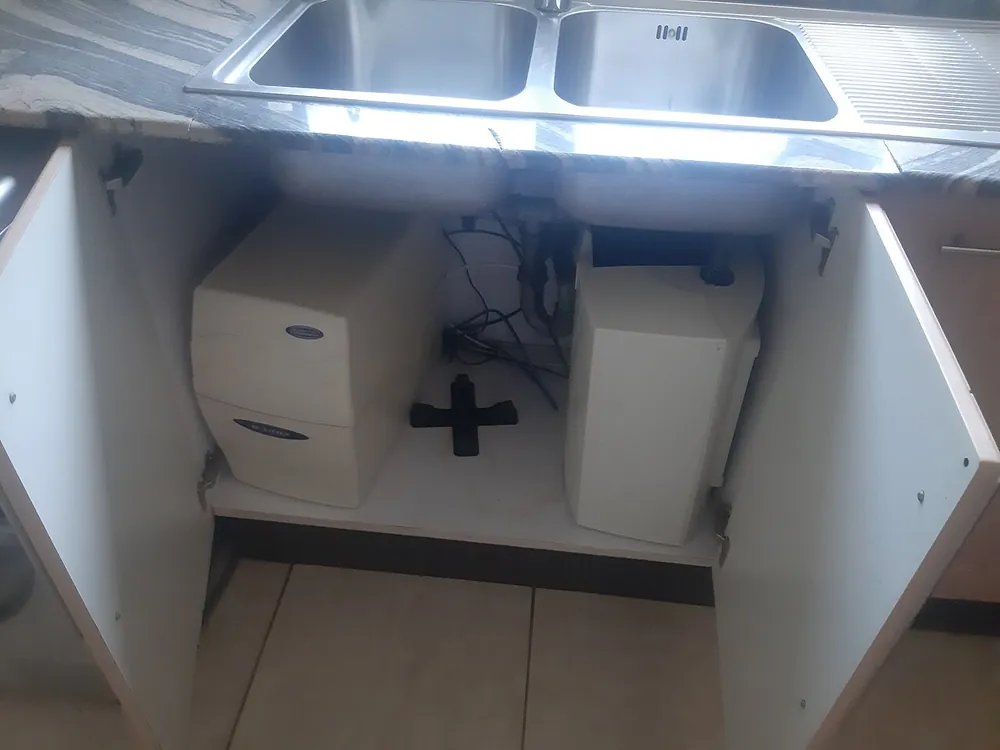
Reverse osmosis (RO) under the kitchen sink is one of the most effective point-of-use ways to cut total dissolved solids (TDS) for drinking and cooking. On hard Texas city water it is also easy to buy the wrong expectation: RO is not a whole-house softener, membranes need enough feed pressure, and very hard water often needs pretreatment. This guide sticks to those practical points, NSF/ANSI 58, and one curated Amazon pick we already document on our filtration page.
RO does not soften the house
An under-sink RO system treats water at one faucet (sometimes a fridge line). Softened feeling water in the shower, less scale in the water heater, and better laundry lather still require whole-house treatment—usually a salt-based softener. The CDC's home treatment overview separates the two: softeners remove calcium and magnesium for the plumbing system; RO pushes water through a fine membrane and can reduce many dissolved salts and minerals in the treated stream, along with other chemicals the maker certifies.
NSF's description of NSF/ANSI 58 requires TDS reduction testing for RO systems and allows optional contaminant-reduction claims. Check the exact certified claims for the model you buy in NSF's listings—marketing "removes everything" language is not a substitute.
If scale and hardness comfort are your main whole-house goals, start with hardness by city, salt-based vs salt-free, and our filter vs softener vs RO decision guide.
Why hard water matters for RO membranes
Hardness minerals that stay dissolved in the feed can precipitate as scale on RO membranes and in related plumbing. Virginia Cooperative Extension's household water treatment publication states that hard water can quickly foul an RO membrane and that a sediment prefilter is frequently used before the membrane, often with carbon stages around it. That matches how most residential under-sink kits are built: sediment and carbon protect the membrane; the membrane cuts TDS; a post-filter polishes taste.
Texas hardness is not one number. Utility-published CCR figures vary from moderate (for example Austin Water's published average around 5.4 gpg in our Austin guide) to very hard (San Antonio SAWS ranges discussed in our San Antonio guide). Read your own CCR—see how to read a Texas water quality report—instead of assuming a statewide average.
Feed pressure: RO needs a push
RO is pressure-driven. If cold-line pressure at the RO inlet is too low, production slows, the storage tank may not fill well, and waste ratios can look worse in practice. Manufacturer specs set the allowed range. For our curated APEC RO-90 pick below, the Amazon listing states a maximum feed water pressure of 85 psi; typical residential RO guidance (and our filtration guide's summary) treats roughly the mid-40s psi as a practical lower end for tank-style systems without a booster pump—always confirm the listing and manual for the exact model.
Before you buy:
- Measure static cold-water pressure at a hose bib or under the sink with a simple gauge.
- If pressure is chronically low, look for a maker-approved booster/permeate-pump configuration rather than forcing an underspec'd membrane.
- If pressure is very high, a pressure regulator may be required by the installer or the manual—do not ignore the stated maximum.
Pre-treatment on hard or chloraminated Texas water
Sediment and carbon that ship with the RO are the first line: they protect the membrane from particles and from chlorine (free chlorine damages thin-film membranes). Replace them on the maker's schedule; dirty pre-filters are a common reason membranes fail early.
Chloramine: Many Texas cities use chloramine rather than free chlorine (see EPA's chloramines page and our filtration guide). Carbon stages in an under-sink RO help at that one tap, but they are not a substitute for a properly sized whole-house catalytic carbon filter when every fixture needs disinfectant reduction.
Whole-house softener ahead of RO: On hard to very hard water, softening the house first reduces scale risk on the RO membrane and gives you soft water everywhere else. Extension guidance that hard water fouls membranes is the reason many Texas installs put the softener on the main line and the RO under the sink on already-softened cold water. Softening also adds sodium (or potassium); people on sodium-restricted diets should ask a clinician before drinking only softened water—RO after a softener typically lowers dissolved minerals again at the drinking tap, which is one reason the stack is popular.
When a softener + RO stack makes sense
Consider softener + under-sink RO when:
- Your CCR hardness is high enough that you already want whole-house scale control (common in parts of San Antonio, Round Rock / Williamson County, and other hard-water metros we cover).
- You also want lower TDS or NSF/ANSI 58–certified reduction at the kitchen faucet for drinking and cooking.
- You accept two maintenance streams: softener salt and regen, plus RO filter/membrane changes and drain wastewater.
Skip the softener-only path if hardness is modest and your only goal is drinking-water TDS—RO alone may be enough at one tap, with honest expectations about showers and the heater. Skip RO if you only care about scale and lather; a softener (or a well-tested salt-free conditioner for scale-only goals) matches that job better.
For softener model fit on city water, see our SoftPro softener guide. One city-water option we cover is the SoftPro ECO City Water Softener (affiliate link). Size it from your own gpg and household use; do not treat RO as a substitute for that sizing.
Curated under-sink RO pick (Amazon): APEC RO-90
We keep one complete under-sink RO product pick on this site—the same unit already listed on the filtration guide—so this page does not become a dump of every Amazon kit. That pick is the APEC Water RO-90 5-Stage Under Sink Reverse Osmosis System (90 GPD; about $210 as of late October 2026). Listing details to verify on the product page:
- NSF/ANSI 58 and NSF/ANSI 372 / WQA Gold Seal claims as shown on the current listing (confirm status there; certifications can change).
- True RO membrane that reduces TDS—unlike under-sink carbon-only or UF kits on our filtration ladder.
- 5-stage under-sink system; storage tank and drinking faucet typically included per the listing.
- Maximum feed pressure 85 psi per the listing; confirm minimum operating pressure and any booster-pump variants in the manual.
Honest limits: the APEC RO-90 is not a water softener and does not treat showers, laundry, or the water heater. It produces drain concentrate as normal RO operation. Installation usually needs a faucet hole (or an existing spare). On hard water, budget for timely pre-filter changes and consider a softener upstream if scale risk is high. We make no health claims beyond what current certifications on the listing cover.
For carbon → UF → RO ladder context, chloramine whole-house options, and other Amazon housings already curated for this site, use the Texas water filtration guide (affiliate links).
Efficiency and wastewater
Conventional POU RO sends reject water to the drain. EPA WaterSense notes that typical units may generate about five or more gallons of reject water per gallon of treated water, while WaterSense-labeled RO systems must meet tighter efficiency criteria and still be certified to NSF/ANSI 58. Compare the efficiency or recovery rating on the NSF listing or product literature, and factor drain volume into homes on septic or strict indoor water budgets.
Bottom line
On Texas hard water, buy under-sink RO for drinking-water TDS and certified dissolved-contaminant reduction at one tap—not as a whole-house softener. Check feed pressure against the maker's range, keep pre-filters fresh, and stack a salt-based softener ahead of the RO when hardness is high enough to threaten membranes or when you also want soft water everywhere else.
Sources
- NSF, NSF/ANSI 58: Reverse Osmosis Drinking Water Treatment Systems
- NSF, NSF Standards for Water Treatment Systems
- NSF, Certified products listings
- CDC, About Home Water Treatment Systems
- US EPA WaterSense, Point-of-Use Reverse Osmosis Systems
- US EPA, Chloramines in Drinking Water
- Virginia Cooperative Extension, Household Water Treatment (BSE-366)
- TCEQ, Consumer Confidence Reports
- Amazon listing for APEC Water RO-90 (ASIN B00HRHHFPW; price and max feed pressure context late October 2026)
- SoftPro ECO City Water Softener product page (checked late October 2026)
Related: filter vs softener vs RO decision guide · chloramine, carbon and RO · SoftPro softener guide · San Antonio hardness · Fort Worth hardness.
Information only; not plumbing or health advice. For water quality questions, contact your utility.